Understanding China’s Collapse | China’s Economy | American ‘Spy’ Arrested


Channel: China Update
Uploaded by China Update on 20260714
Categories: News & Politics
Tags:
Read the full, in-depth text analysis breaking down this macroeconomic shift on our portal: https://chinanewsupdate.com/chinas-economy-slows-as-the-ai-export-boom-masks-deeper-domestic-weakness/ China’s high-tech manufacturing sector is surging on the back of an artificial intelligence export boom, yet this phenomenal success masks

Here is a detailed breakdown of the content from the YouTube video titled "China Sees Largest Crash In Modern History | China’s Economy | American ‘Spy’ Arrested" from the channel China Update, hosted by Tony.

1. Macroeconomic Overview: The Second Quarter of 2026 [00:23]

China’s economy has significantly lost momentum in Q2 2026, showcasing a widening gap between a booming, AI-driven export sector and a weak domestic economy suffering from a prolonged

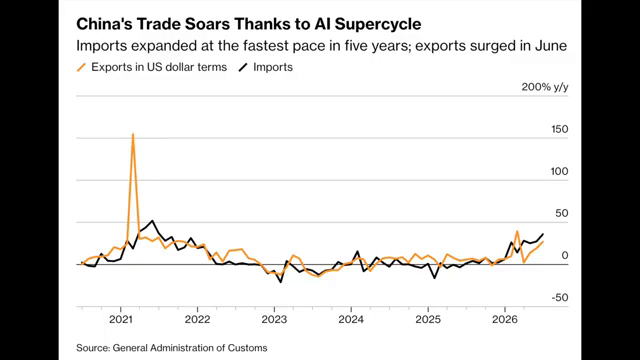
Image for chunk 1

property slump, reduced investment, and fragile consumer confidence.

GDP Metrics: Economists surveyed by Bloomberg expect year-on-year growth to slow down to 4.5% (down from 5% in Q1). This sits at the absolute bottom of Beijing's annual target of 4.5% to 5%. Quarter-on-quarter growth has decelerated to 0.9%, the weakest since 2023.

Domestic Challenges: Fixed asset investment continues to decline, with a projected 5% drop in the first half of the yea

Image for chunk 2

r. Real estate investment has plummeted by nearly 17%. Furthermore, local governments are tightening their fiscal belts to prioritize debt reduction over new infrastructure projects.

The AI and Export Boom: Conversely, external trade is booming. June exports surged by 27% and imports jumped by 36%, resulting in China's second-largest monthly trade surplus on record ($125.6 billion). This explosion is explicitly fueled by global investments in artifici

Image for chunk 3

al intelligence, increasing demand for semiconductors, AI servers, and data center equipment.

CHINA'S TWO-TIERED ECONOMY (Q2 2026)

+------------------------------------------+------------------------------------------+

| DOMESTIC WEAKNESS | EXTERNAL BOOM |

+------------------------------------------+------------------------------------------+

| * Q2 GDP growth down to 4.5% | * June Exports:

Image for chunk 4

+27% |

| * Real estate investment: -17% | * June Imports: +36% |

| * Vehicle sales falling for 7 months | * Record monthly trade surplus: $125.6B |

| * Local government fiscal tightening | * Driven heavily by global AI demand |

+------------------------------------------+------------------------------------------+

2. Geopolitical Tensions: Arrest of US Seismologist [03:35]

The video cove

Image for chunk 5

rs a major Reuters report detailing the nearly two-year detention of a Chinese-born American scientist, which is adding further friction to Washington-Beijing relations under the Trump administration.

The Detainee: Chen Yolin, a 54-year-old U.S.-based seismologist, was arrested by Chinese state security at Beijing Capital International Airport on November 5, 2024. He had been visiting family and lecturing at Chinese universities.

The Allegations: Chen

Image for chunk 6

conducted U.S. government-funded research tracking North Korean nuclear tests via seismic monitoring. He now faces a trial on espionage charges. The U.S. State Department, led by Secretary of State Marco Rubio, has officially designated him as "wrongfully detained."

Broader Impact: This is the second high-profile academic/think-tank detention this year (following Myanmar scholar Menzen in June). Experts indicate these arbitrary national security arre

Image for chunk 7

sts are creating an outsized negative psychological impact on international academics and researchers considering travel to China.

3. Economic Debate: Did China Actually Avoid a Crash? [06:46]

Tony examines the deep-rooted structural crisis of the Chinese property market bubble through the perspectives of two prominent macroeconomic experts: economist Noah Smith and Peking University professor Michael Pettis.

Noah Smith's Argument: "The Masked Crash"

Image for chunk 8

[07:01]

Smith argues that while Beijing successfully prevented a visible Wall Street-style banking meltdown and maintained positive official GDP growth, the economy absolutely experienced a massive crash. It was simply masked by aggressive state intervention and adjusted statistics.

Evidence: Surging youth unemployment forced Beijing to change how the data was calculated; alternative labor metrics revealed worsening conditions for migrant workers.

Ind

Image for chunk 9

ependent Analysis: Research bodies like the Rodium Group, Bank of Finland, and Capital Economics conclude that China's post-property recovery is drastically weaker than reported, estimating the economy likely contracted in 2022.

Michael Pettis's Response: "The Bubble Replacement Strategy" [10:01]

Professor Michael Pettis expands on Smith’s arguments, explaining that China's state-controlled banking system avoids economic shocks not by allowing the sys

Image for chunk 10

tem to naturally adjust, but by continuously inflating a new investment bubble to offset the deflation of an old one.

Pettis charts this chronological progression using historical parallels:

CHRONOLOGY OF CHINA'S REPLACEMENT BUBBLES (According to Michael Pettis)

=============================================================================================

[2009 Post-Financial Crisis]

Collapse in trade surplus balanced by inflating a massive INFRASTRUC

Image for chunk 11

TURE BUBBLE.

Result: Built more infrastructure than the economy could productively absorb; created debt.

|

v

[2015 - 2016 Adjustment]

To ease off infrastructure spending without pain, Beijing inflated a massive PROPERTY BUBBLE

by lifting purchase limits, lowering down payments, and forcing banks to expand mortgages.

|

v

[2021 - 2022 Property Burst]

Evergrande and the property market collapsed. Beijing matched the real estat

Image for chunk 12

e decline dollar-

for-dollar by pouring state credit into a new MANUFACTURING BUBBLE.

|

v

[Current Day Result]

Because China was already over-reliant on manufacturing, this pivot triggered severe domestic

overcapacity, massive industrial "involution", and an aggressive, contested trade surplus.

=============================================================================================

Pettis's Core Conclusion [13:15]

This bubble replac

Image for chunk 13

ement strategy cannot continue indefinitely. To keep economic activity moving forward, each consecutive bubble must be significantly larger than the previous one. This has caused China's debt burden to expand at the fastest rate in modern history, resulting in a rising debt-to-GDP ratio that signals highly unproductive, state-directed investment.

China Sees Largest Crash In Modern History | China’s Economy | American ‘Spy’ Arrested

China Update · 47K

Image for chunk 14

Viewer Discussion & Comments

@roberthawley40
Thanks, Tony!
@mikefellbach6841
Once again Tony is using provocative titles and then usually keeps pumping out fake GDP growth numbers. Who believes the economy is growing at more than 3%. You are treating your viewers like idiots.
@robertsalvia4406
You must be new to this channel or YT